Showing posts with label Economics. Show all posts

Monday, April 26, 2010

Economics (Inflation)

GREASE THOSE WHEELS (ECONOMICS)


#3 UNEMPLOYMENT


  • Employment Statistics
  • Size and components of labour force
  • Labour productivity
  • Definition of unemployment
  • Unemployment rate; patterns and trends in (un)employment
  • Difficulties involved in measuring unemployment
------------------------------------------------------------------------------------------------------------------------
Unemployment? We all are familiar with this word, living in today's world, but have you ever tried to get deeper into this stuff; like what causes it and what are its consequences. No? I was expecting that! So lets just explore this phenomenon which we hear about almost everyday!!
------------------------------------------------------------------------------------------------------------------------
First of all we should know as to how we measure via the employment statistics the rate of unemployment in a country. Simple...
  1. The total civilian labour force (people who are aged 16 or above and are employed or actively searching for unemployment) is determined.
  2. Next the number of unemployed persons is determined (the people who are actively looking for jobs or have not worked for more than an hour in the week before the survey was conducted)
  3. Exclusion of people who are employed by the military, have a long term illness or are voluntarily unemployed.
  4. Unemployed Persons / Total Civilian Labour force x 100 = Unemployment Rate.
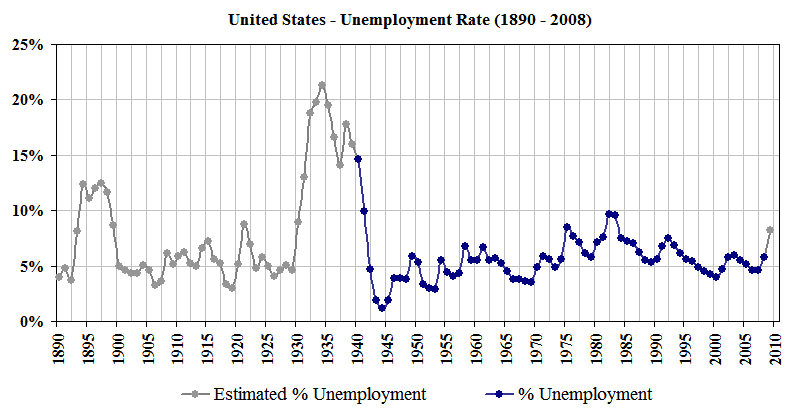
The above figure showing the unemployment rates of the U.S shows that unemployment is a dynamic concept and keeps on changing with time as more people come of working age and start finding jobs or get jobs along with other people who lose their jobs. So at a given time if more people get jobs and lesser people lose their jobs, the rate of unemployment will drop, and vice versa.
Some 'jumps' in the above graph are explained...
  • 1929 and onwards was the Great Depression the period of great economics instability around the globe. Revenues dropped for firms and so they started striking off people from their factories.
  • 1945 was the year when the U.S went all out in war against the Nazis, more of everything was required in the country, more ammunition, more food and more clothing. Thus as a result unemployment dropped (people became self employed as well) to an all time low as America coped with the war and the GNP almost doubled.
  • 1970-71, 1974-75, 1980-81, 1983-84, 1991-92, 2003-04 were all recession years in the U.S economy.
  • In 2008 another period of economic recession hit the world and unemployment is increasing and expected to increase.
Additionally unemployment is also very difficult to measure because...
  • Data collection may not be accurate or may be subjected to mathematical errors or a wrong response from the people surveyed.
  • Some people of working age may not prefer to work due to family business or other causes.
  • Data collection is very time-consuming and expensive.
  • People might disguise their unemployment.
  • They dynamic nature of unemployment makes it difficult to keep track of so many changes.
  • frictionally and casually unemployed portion of the labour force is difficult to measure.
------------------------------------------------------------------------------------------------------------------------
Now let us look at the costs and effects of unemployment...
  • Total economic output decreases, i.e the GDP, (as it is the next best alternative) as the available manpower decreases. It is known as the GDP gap and is shown as the distance between a point inside a PPF and a point on the PPF.
  • Unemployed people's benefits also put an extra burden on the governement.
  • Increase in the Misery Index which is also known as the discomfort index which is the sum of the rates of inflation and unemployment and depicts the suffering of an individual.
  • The uncertainity that lurks when unemployment exists severely hinders economic growth, as worker insecure about their jobs do not make some buyings which results in decreased revenues for firms and thus they start increasing prises, contributing to inflation. Government also reduces spending on social welfare projects like construction of roads etc as it is unsure about the tax revenues it will get.
  • Loss of revenue to the governemnt in the form of decreased income taxes and national insurance.
  • Economic instability also contributes to the political instability of a nation. For example a government that has failed to cope with unemployment and other economics vices is tagged as useless and an average voter starts to look for changes. Bill Clinton's victory over George Bush in the 1992 elections is largely contributed to the recession of 1991.
  • Loss of self confidence of the individual.
  • Increased crime rates, family break-ups, suicides and other social vices.

------------------------------------------------------------------------------------------------------------------------
Now let us look at the different sources of unemployment that exist on this planet of ours...=P
  • Frictional Unemployment is caused by people quitting one job and looking for another one, in other words, when workers are between jobs. This is usually for a short period of times. As long as freedom of choice exists for workers, there always be some frictional unemployment.
  • Structural Unemployment results from economic growth, changes in consumer tastes or any other factor that changes the way an economy operates and thus reduces the demand for some workers. It may also be due to outsourcing (the hiring of foreign firms to carry out not-that-important functions for a local company like customer support, availability of technical support, an example is the Hewlett-Packard Company. It is mostly done to lower operational costs). Some examples are...via economic growth; the advent of automobiles resulted in a decreased demand for horse-carriage makers and they went out of business due to structural unemployment, via changes in customer's tastes, popularity of Toyota automobiles resulted in structural unemployment in the U.S company, Ford, via the government, the 1990 closure of many military bases resulted in structural unemployment.
  • Technological Unemployment occurs when simply put, machine take over the work from workers. Thus making the worker's skills obsolete. Since the advent of computers such unemployment had been steadily on the rise. Although some say it should be linked with the structural unemployment bu the magnitude of the two unemployments keep them apart with technological unemployment not on that large scale as structural unemployment goes on. Examples can be of proof-readers as spell-checking programs appeared, database managers as database managing programs appeared.
  • Cyclical Unemployment is related to swings in the business cycle that forces firms to put off some workers until economic conditions improve, which is usually after several years. Economic instability such as recession usually results in millions of jobs being lost and is an example of cyclical unemployment.
  • Seasonal Unemployment results from changes in demand for a specific type of workers at regular intervals or at fixed times every year. Example can be of crop-harvesters who are required in under-developed countries like India when the season of crop harvest arrives and are unemployed for most of the year.
------------------------------------------------------------------------------------------------------------------------
Labour productivity is another examiner favourite when talking about MCQs...here are some facts to remember...

  • It is given by the formula Total Output/Total Employed Workers x 100.
  • It is a measure of quantity of good produced by one worker in a firm.
  • Here are some factors that affect labour productivity.
    • Experience...the more the experience the more the productivity.
    • Attitude towards the job...if it is loyal then increased productivity but if it is that of burden and half-heartedness then lesser the productivity.
    • Wages; the lower the wages the lower the productivity and vice versa.
    • Attitude of supervisor. It matters a lot if it is encouraging then good going, but when it gets overly bossy then......=P
    • The use of newer technology.
    • The facilities provided to workers.
------------------------------------------------------------------------------------------------------------------------
Thats all from this topic....see you later with some other boring component of your syllabus...=PP


Sunday, April 25, 2010

Economics (Trade-2)

GREASE THOSE WHEELS (ECONOMICS)


#2 ABSOLUTE and COMPARATIVE ADVANTAGE

  • Principles of absolute and comparative advantage, and their  real-world limitations
  • Other explanations/determinants of trade flows
  • Opportunity cost concept allied to trade

------------------------------------------------------------------------------------------------------------------------
Trade and specialization is necessary for everyone to be better off...think about a world where there is no specialization and no trade between countries...then you will have to grow your own food, make [!] your own hairgels, you would ever have a feel of CK Jeans, Harley Davidsons would just remain to pictures and Toyota would have been localized to Japan only. I think you are starting to see the benefits of trade...=P!!
Some well known facts about trade are...

  • Trade occurs only when both the parties are benefited.
  • Trade involves importing and exporting of goods.
------------------------------------------------------------------------------------------------------------------------
Now lets move to the very important question that why do countries trade??
The answer is simple, nations trade so that they can get goods from other countries that are more expensive to produce at home and meanwhile focus their resources on good they specialize in and then sell them to the world.
So the boil down of the above mentioned reason is that nations trade because of specialization. Nations produce goods that they produce efficiently and trade them for goods that they are not good at producing [tongue twister, anyone? =P]. For example Kenya specializes in the production of tea by focusing its resources on it and then trades it with nations like France who are less efficient at producing tea for other goods like packaging machinery which they are not that efficient at producing.
So we can safely say that specialization is the heart and soul of international trade.

Moving on to the concept of absolute advantage.
It is defined as a country's ability to produce more of a good or service than another country.
Before we look at it we should see the system's assumptions first.
  • Transportation costs are zero.
  • There is no imposition of tariffs or custom duties on the import of that good.
  • Prices are to remain constant.
  • There are only two countries X and Y in the world.
  • There are only two goods produced in the world.
For example we draw the PPFs of two countries Alpha and Beta and both of them produce two goods mangoes and oranges...
Before specialization...Alpha produces 10 mangoes and 15 oranges. While Beta produces 20 mangoes and only 10 oranges but afterwards both the countries specialize in the production of the fruit they are good at and so Alpha produces 25 oranges now and 0 mangoes while Beta produces 30 mangoes and 0 oranges and so we say that Alpha has an absolute advantage in the production of oranges while Beta has the absolute advantage in the production of mangoes.

Now let us look at the more complex comparative advantage.
It is defined as a country's ability to produce a good more efficiently or at a lower opportunity cost then other countries.
For example we again draw the PPFs of two countries Gamma and Bravo and, again both of them produce only two goods wheat and rice.
Before specialization...Gamma produces 5 tons of wheat and 10 tons of rice. While Bravo produces 20 tons of wheat and 60 tons of rice. Complex, eh? No scene of absolute advantage here so we resort to the good old concept of opportunity cost.
  • Opportunity cost for Gamma on the production of a ton of wheat is (10/5) 2 tons of rice.
  • While the opportunity cost for Bravo to produce a ton of wheat is (60/20) 3 tons of rice.
So Gamma has a comparative advantage on the production of wheat as it produces it more efficiently than Bravo, i.e, its opportunity cost of production of a ton of wheat is lower than that of bravo.
Now let us look at the opportunity costs for the production of a ton of rice for the two countries.
  • Oppertunity cost for Gamma on the production of a ton of rice is (5/10) 1/2 tons of wheat.
  • While the oppertunity cost for Bravo to produce a ton of rice is (20/60) 1/3 tons of wheat.
Here Bravo has a comparative advantage in the production of rice.
------------------------------------------------------------------------------------------------------------------------
Now let us look at it with the aid of graphs and we will then look at the advantages of specialization.
  • The unbroken PPFs show the before trade scenario of production for the two countries. U.S has a comparative advantage in the production of food (as it has to give up 2 units of clothing in producing a unit of food compared to the 4 units of France). While France has a comparative advantage in the production of clothing as it has to forgo 1/4 unit of food in the production of a unit of clothing compared to the US's 1/2 unit of clothing.
  • So by the law of comparative advantage France should specialize in and export clothing while the U.S should divert all its resources on the production of food and export it.
  • After specialization, look at the intercepts of the PPF for the only good the country has chosen to produce. As we see U.S would make 500 units of food while France would produce 1200 units of clothing.
  • Assume the terms of trade (average export price/average import price) for these goods in the international market will be 1 unit of food for 3 units of clothing (it should be less than 4, the before-trade relative price of the good so that France finds some benefit in trade) a further assumption is that a country sells all what it produces so by this France will have 1200/3 = 400 units of food (mind that 450 on the graph!...=P) more than the maximum of 300 it had before trade. While the US will have 500x3 = 1500 units of clothing, which is 500 more than the before trade, maximum quantity of that good. These changes are shown by the broken curves in the above figure, known as the consumption possibility curve.
  • Look at the two graphs again, did you find out that the citizens of the two nations are better off after trade! The U.S citizens can now get 600 units of clothing along with 300 units of food (by exporting 200 units of food) which is better than the before trade situation when a U.S citizen would have gotten 600 units of clothing along with 200 units of food (by exporting 600 units of clothing). Same is the case for France.
  • The imports are shown by the amount of goods a country consumes which it doesn't produce. It is 600 units of clothing for the U.S and 300 units of food for France.
From this stuff we can deduce that...
  • After trade both countries will end up with more of each good.
  • The terms of trade will fall between the before trade prices of the good in both the countries (it was 4 for France and 2 for the US, thus the TOT was 3).
  • Total world output will increase.
------------------------------------------------------------------------------------------------------------------------

Although this theory looks quite good on paper, but in real world it has severla limitations...

  • Existence of tariffs and transport costs reduces benefits from trade.
  • Constant costs in real word are way to unrealistic. The more the production of a good the lower its cost should have been. So the negotiations of terms of trade gets a bit difficult.
  • Governments cannot simply close down industries which they do not have a comparative advantage in due to political unrest.
  • During periods of turmoil like war countries can suffer as foreign trade comes to a halt for that country as the country are too dependent on other countries after specialization.
  • Some strategically important goods like weapons and steel should be produced by a country to support it during times of turmoil.
  • Specialization is harmful at a great extent. For example, Saudi Arab is a country that is too dependent on oil for economic growth. Lower prices of oil can really put a halt to economic activities in  such countries so a little diversification should be there to cancel out such harmful build-ups.

------------------------------------------------------------------------------------------------------------------------

Monday, April 19, 2010

Economics [Trade-1]

GREASE THOSE WHEELS (ECONOMICS)


#2 INTERNATIONAL TRADE ISN'T THAT EASY AFTERALL!!

  • Describe and explain arguments for free trade and motives for its protection.
  • Describe the types of such protections and their effects.
  • Economic integration in the form of free trade regions, economic unions and custom unions.
------------------------------------------------------------------------------------------------------------------------

Free International Trade for all is a good thing when seen from our point of you as it depicts freedom and easy mobility but for some wicked entrepreneurs and countries as a whole, this is not the case as free trade might result in displacement of a single industry from the international market or even a single group of workers. Thus to protect such interests some restrictions to prevent free trade are imposed by countries.

Two major ways to reduce free trade between countries are tariffs and quotas. Lets take a look at their effects individually.

TARIFFS
Tariffs are a type of tax that is levied on imported good to raise their price in the national market. Their are two main types of tariffs, protective and revenue tariffs. A protective tariff is imposed to protect less efficient domestic industries with their production woes. For example if a can of paint can be imported and sold in the domestic market for $25 but a domestically produced can of the same type of paint costs $28. In this scenario government doesn't want its owns products to be dominated by foreign ones so it levies a protective tariff of $5 on the imported can of paint to protect the well being of the domestic industry. (After imposition of tariff the imported can of paint will cost $30 while the domestically manufactured one would cost $28).
A revenue tariff is put up by the government, as the name suggests, to build up revenue without putting a complete stop to imports. Historically, tariffs were mostly imposed  by governments to generate revenue, from Civil War till 1913, tariffs made up about 1/2 of the total US revenue generated!!
Lets talk about some graphs now...


  • $10 is the equilibrium price, i.e the price without trade, with full domestic production.
  • $6 is world price of this specific type of clothing.
  • $8 is the price of that clothing in that specific country after imposition of $2 tariff.
  • S is the domestic supply curve.
  • D is the domestic demand curve.
  • W-S is the world supply curve of this type of clothing.
  • After imposition of tariff these changes occur;
    • Imports decrease from 400 units (700-300) to 200 units (600-400).
    • Domestic production increases from 300 units to 400 units.
    • Area E is the increased profit to domestic producers (400x2-Area of Triangle A= $700)
    • Area A is the cost of below optimal production, it depicts the increased price an average consumer is paying in this country after increased production by domestic industries. (1/2x100x2 = $100). It can also be said as the loss in consumer surplus which is the amount a consumer is willing to pay above the original price of the product.
    • Area B is the amount of revenue collected by the government after the imposition of tariff. (200x2 = $400).
    • Area C is the loss in consumer surplus which is the amount a consumer is willing to pay above the original price of the product. It falls because of the fall in demand form 700 units to 600 units. (1/2x100x2 = $100)
    • Area A+B+C+E is the loss to consumers after the imposition of tariff, i.e, $1300.
    • Area B+E is the benefit to producers and government respectively, i.e, $1100.
    • Area A+C is the deadweight loss as no one benefits from this. Total Loss - Total Benefit, $1300-$1100 = $200.
So basically the outcome of tariff imposition is, reduced consumption, minimization of imports and increased domestic production of that good.


    QUOTAS
    Some times a foreign made good is so dirt cheap that even an imposition of tariff would not affect its demand in the domestic market and the local industries would suffer. In such a case the government imposes a quota on such goods to limit their entry into the country. A quota can even be set to zero so as to completely bar a good's entry into that country.
    A very good example of quota imposition can be the one imposed on the imports of cheaper Japanese Automobiles into the US market by President Reagen in 1981. This limited the diversity of choice for an average American in the automobile section and the prices got higher with decreased number of cars. The Japanese firms involved 'voluntary' reduced exports in this case after negotiations with the US Government, why? Read ahead to see...
    A quota, if imposed properly, serves the same purpose as of a tariff. Reduction of imports, increased production by local firms and decreased demand after increased prices. So in the above mention graphed lets replace this tariff thingy with the quota one. With a play of words we say that the government has fixed the quota of imported clothing to 200 units and as a result the price shot up to $8, all of the areas and stuff remains the same as for the tariff one, the only change being in the Area B. Now this extra money isn't going in the pockets of the government but the importers!! For example the importers bought the clothing for $6 a unit and they are now selling it at $8 a unit!! This means they are getting a profit of $2 per unit so this revenue is paid back to the international firms for 'voluntarily' lowering their exports. See!!


    These are not the only things a government can do in order to curtail imports. It can rigorously inspect the goods for health, start a condition for licences importing of that good or ban the entry of some goods on cultural or religious bases. Examples are given below...

    • Argentinian beef not allowed to enter in the U.S on health grounds for many years.
    • Many European countries like Albania, Belarus etc don't import genetically modified food crops from U.S and Canada on cultural grounds.
    • Quite a few European countries have banned the imports of Pakistani canned fish on the basis of poor hygiene of factory workers.
    • Pork and other food products related to it are banned forever in Islamic countries on religious bases.

    ------------------------------------------------------------------------------------------------------------------------


    As described earlier many producer don't want free trade to occur because it might lead to unemployment and other economic vices.
    For example trade causes India to shift production from textiles to agricultural products. This might result in frictional employment between jobs for workers displaced from the textile industry into the agricultural one but in the end they get better off by earning higher wages form such movement. But the case is not that simple, workers are usually specialized in what they do for example a textile machine operator would have little knowledge about the functioning of a combine harvester. So such a scenario results in an unemployment for many of the textile industry workers or them working at much lower wages.
    So here is this great argument b/w people who advocate free trade with little or no restrictions (free traders) and those who are on the side of tariffs and other trade barriers to protect domestic industries from foreign competition (protectionists)...
    This argument is centered on these six points. (we will give you the takes of both protectionists and free traders)

    • The first point that protectionists take up is the matter of National Security, they say that following a free trade route a country becomes too specialized and becomes dependent on other countries and during crisis situations like wartime the country doesn't have its owns resources to fulfill needs for critical goods such as oil and weapons. Free traders admit this point but they state that the quality and efficiency of these goods might be lower when produced domestically then when imported with free trade. They also state the hassle of determining which industries and critical and which are not.
    • The most strong argument of the protectionists is the infant industry argument they take up the stance that newly 'born' industries need some time to settle down before they can be subjected to international competition. So imposition of Tariffs on goods imported by a country that are also starting to get produced in that country is viable for the domestic success in production. Free traders also agree on this point of the protectionists if only the tariff imposed on the import of such goods is removed after their domestic producers have settled. They also give the example of Latin automobile industries for whom the government had imposed tariff of several hundred percent on competitive foreign automobiles companies. The result? These Latin countries have grown accustomed to zero competition and so have the government officials to huge amount of revenue and so these industries have never produced a globally competitive car.
    • Protectionists also argue that trade barriers should be there to protect domestic jobs. Cheaper goods form foreign industries puts the future of more expensive domestically produced goods in jeopardy. The profits of such domestic industries go down and unemployment and low wages results. While free traders argue that while inefficient industries are supported the prices go up and the standard of living go down. Such results force people to look for substitutes and the essence of tariff imposition is lost. Free traders also state that the profit-and-loss system is an integral part of the economic system; the efficient should be rewarded and the inefficient should be eliminated.
    • A weak point of the protectionists is Keeping the Money at Home, they argue that for e.g, The pound sterling should remain in the UK rather than flow out in the international market. The free traders counter this point by saying that eventually the pound will return to home, for e.g if these pounds are used to buy oil from the Middle East, and the currency flows out, but when the same middle east companies import capital goods or agricultural products form the UK the pound will go back to where it came from. Moreover such transfer of currency will also help overseas UK workers.
    • Trade Barriers help the balance of payment by reducing deficit, is what the protectionists say. Free traders argue that the protectionists overlook the fact that the money that flows into the country upon exports and in the form of investment that simulate employment and economic well being.
    • A final argument given by the protectionists is a nation's pride and dignity. France for example is proud of its wine and cheese and serves to protect such industries. Free traders catch this point but still they do not budge from their stance that permanent protection should not be there, even for industries that constitute a nation's pride.
    Which side are you on? Hmm...well most of us will chose the right side to be on, because tariffs harm more than they benefit. For e.g, in 1930 the U.S Government passed a Tariff act that would impose a 70% tariff on most goods that are imported into the States, as a result imports dropped drastically along with retaliation from other countries and international trade b/w the U.S and the rest of the world almost came to a stand still.
    So organizations like the World Trade Organization (WTO) helped member countries to sign trade agreements under the GATT (General Agreement on Tariff and Trade), solve trade disputes and finding markets for newbies. As a result free trade is now flourishing.
    ------------------------------------------------------------------------------------------------------------------------

    Regional economic cooperation is always helpful to member nations by aiding trade agreements and the economics well being of their people. Below are three of the most common ways to promote regional economic cooperation.

    • In a free trade area two more countries abolish all tariffs and quotas between each other to promote trade between them. The two countries doesn't necessarily have similar trade barriers for non-member countries.
    • A custom union is a more developed from of the free trade region. In it two or more countries annihilate all trade barriers between them and adopt uniform tariff plans for other non-member countries.
    • An economic union is a far more developed form of the custom union in it countries belonging to a certain geographical region form a trade bloc with a single market and a common currency. Examples are European Union (Euro), East African CFA (Franc), West African CFA (Franc), Eastern Caribbean Currency Union (Dollar).
    An important point to notice here is that OPEC (Organization of Petroleum Exporting Companies) is not a trade union but a cartel, which is a group of producers that increase the price of the product they produce by restricting its availability.

    Thats all....whewwww!!


    Sunday, April 18, 2010

    Economics (Balance of Payments)

    GREASE THOSE WHEELS (ECONOMICS)


    #1 BALANCE OF PAYMENTS

    The only thing you are expected to know about balance of payments in the AS Level Economics syllabus is...
    • Explain the Components of Balance of Payments.
    --------------------------------------------------------------------------------------------------
    Well Balance of Payments (BOP) can be thought of as a country's virtual economic logbook. It has the records of all the money that flows into and out of a country. Such movement can occur in in the following ways;
    (Credit is inflow of foreign exchange while debit is outflow)

    • Exports (Credit)
    • Imports (Debit)
    • Aid and Funds (Credit)
    • Payment for Services, such as banking, advertisements.
    • Cross-border dividend and interest rate payments.
    • Remittances sent by overseas workers. (Credit)
    • Foreign Investments (long term capital inflows)
    • Speculative Investments in currency markets and stock exchanges (short term capital inflows).
    They are bracketed in the Balance of Trade part of the Current Account which is a component of balance of payment that records all foreign exchange inflows and outflows. Balance of Trade, well, deals with all the monetary transactions that are occurring at a country's outlets (i.e, ports). It is very important in determining the competitiveness of a country in the global market.. Balance of Trade focuses on all types of goods that are transferred between for e.g, Pakistan and the rest of the world.
    These are part of the Invisible section of the Current Account and account for the exports and imports of services only. Which include the payment to shareholders of a business (dividend) which reside in other countries, portion of wages transferred by overseas workers to their family back at home (remittances), interest received from money kept in foreign banks and all other transactions which involve intangible goods (goods that cannot be touched) such as transfer of copyrights etc.
    These make up the Capital Account part of the Balance of Payments' logbook. Short term capital inflows are purely speculative in which an investor invests a part of his investment in a country's stock exchange or currency market when he/she sees some positive future development, like increase in the value of the currency of that country or growth of an industry that is listed on that specific country's stock exchange. Long term capital inflows are more measured and are the investments in a running business at a country. For example if Japan sets up a water purification/desalination plant in Saudi Arabia. But such inflows come at an opportunity cost, that are the dividends/portion of profits sent back to the Japanese investors. Law and Order situation of a country, tax rates, interest rates, expectations for profits and government policies are some of the factors that affect long term capital investment.


    Balance of Payment disequilibrium can be of two types. A deficit and a surplus a surplus (depicted by a -ive sign :-O) is when money inflow exceeds money outflow and the monetary reserves of a country build-up while a deficit (signified by a +-ive) occurs when the opposite occurs. A country, necessarily, likes to have its balance of payment in equilibrium, and it should remain like that, but in real life such a thing doesn't occur and the surplus-equilibrium-deficit cycle rolls on. Let us outline some of the things that result in a balance of payment deficit...

    1. When the imports of a country exceeds its imports.
    2. When the exchange of services b/w the countries are more inclined towards debit.
    3. When there are a large amount of loans taken by the country from other countries/organizations. Until such loans become grants, the foreign exchange used to pay back these loans with interests would result in a current account deficit.
    4. Decreased investment in a country due to political \ economical instability or other crisis situations that discourage investors.
    5. Appreciation (increase in value) of the country's currency in the international market which results in imports getting cheaper for the citizens while exports getting expensive for foreign buyers thus resulting in increased imports and decreased exports.
    6. When a country is on road of technological advancement and economic well-being then it imports more capital goods and machinery which might result in a temporary BOP deficit but will benefit the country in the long run.
    7. When a major importer of a good from the country starts imposing heavy tariffs (taxes on imports), quotas or a complete trade embargo on that country then a severe BoP deficit is observed. For example Iran imports, say 90%, of its tea from Kenya but the Iranian government finds the Kenyan tea as of low quality or has found cheaper substitute for it then it will subsequently reduce imports for it and such a move will also leave a negative impact on other Kenyan tea importing countries and effect the overall BoP (deficit) of Kenya.
    8. Inflation in a country will also result in its exports being expensive in the foreign market. Which will persuade importing countries to scout for better alternatives and effecting the BoP (deficit) of the country in question.
    Some things that result in a balance of payment surplus are...
    (most are contrary to the above given statements, exceptions are listed below)

    1. Basically, increased exports and decreased imports result in such a phenomenon.
    2. A country advances technologically which results in increased quality and quantity of its goods in the international market. Better quality at a the same or lower price is bound to get the importer's attention.
    We will be discussing measures to correct balance of payment disequilibrium when we have completed the exchange rates part of the syllabus.